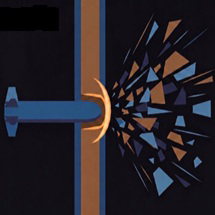
Armor Sandbox APK introduces a highly technical 3D terminal ballistics sandbox designed for users who want to explore how armor and projectiles behave under simulated impact conditions. Instead of relying on health bars, hit points, visual effects, or scripted damage animations, the experience focuses on mathematical and physics-based simulation.
The central question behind ArmorSim is straightforward: will the projectile penetrate the armor?
Players can construct their own targets by combining armor plates, different materials, thicknesses, angles, and spacing. They can then select or configure projectiles and observe how the simulated impact develops. The resulting deformation, penetration, erosion, fragmentation, and residual velocity are calculated by the simulator rather than simply being displayed as predetermined animations.
For anyone interested in armor simulation, terminal ballistics, material behavior, projectile penetration, and physics-based experimentation, Armor Sandbox offers an unusually detailed sandbox environment.
What Is Armor Sandbox APK?
Armor Sandbox APK is associated with ArmorSim, a 3D terminal ballistics simulation environment built around physics-based penetration modeling. The simulator allows users to construct armor configurations, select projectile characteristics, launch simulated impacts, and inspect the resulting damage.
Rather than presenting armor as a collection of arbitrary hit points, the simulation uses material properties and mathematical models to determine what happens during an impact.
Depending on the selected solver, users can examine phenomena such as:
-
Projectile erosion
-
Armor plate deformation
-
Penetration and perforation
-
Plug formation
-
Ragged hole formation
-
Fragment generation
-
Residual projectile velocity
-
Energy loss through multiple armor layers
-
Ricochet behavior
-
Material failure
The result is closer to a ballistics laboratory sandbox than a conventional mobile action game.
Build Your Own Armor Target
One of the most interesting features of ArmorSim is its free-build scene editor.
Instead of being limited to predefined targets, users can create their own armor arrangements. Plates can be added, moved, rotated, and assigned different materials.
This makes it possible to experiment with configurations involving:
-
Single armor plates
-
Multiple layers
-
Spaced armor
-
Different plate thicknesses
-
Angled armor
-
Composite arrangements
-
Ceramic and backing combinations
-
Reactive armor configurations
Changing even one variable can produce a different simulated result, making the editor useful for experimentation and comparison.
Select the Projectile and Fire
After constructing a target, users can configure the projectile or choose from a selection based on ammunition associated with American, Soviet/Russian, and German arsenals.
The purpose is not simply to watch a projectile hit a plate. The simulator attempts to calculate what happens during the interaction between the projectile and target.
During penetration, the projectile can lose material and energy while the armor can deform, tear, fracture, or eject material.
This creates a much more detailed representation of terminal ballistics than a simple damage-number system.
Three Simulation Solvers
ArmorSim provides three different solver modes, allowing users to choose between rapid experimentation and computationally intensive simulation.
NORMAL Solver
The NORMAL solver is designed for speed.
It uses analytical terminal-ballistics models to calculate the outcome in a fraction of a second. This makes it particularly useful when users want to perform repeated experiments.
You can fire a simulated shot, change one parameter, and immediately run another test.
The NORMAL mode incorporates models including:
-
Alekseevskii–Tate erosion integration
-
Recht–Ipson residual velocity
-
Rosenberg ricochet criterion
-
Grady fragmentation
Because calculations are relatively fast, this mode is well suited to comparing different armor thicknesses, projectile conditions, angles, and material selections.
ADVANCED Solver
The ADVANCED mode exposes more of the underlying calculation.
It supports layered and spaced armor configurations and provides per-layer energy accounting. This allows users to see how the projectile changes as it moves through multiple layers.
The simulator can report values such as:
-
Ballistic limit
-
Wear fraction
-
Residual velocity
-
Energy consumption
-
Layer-by-layer projectile behavior
This makes ADVANCED mode particularly useful when studying multi-layer armor penetration.
Instead of simply receiving a final result, users can inspect where the projectile lost its energy and how individual plates contributed to stopping it.
ULTRA Solver
The ULTRA solver is the most computationally demanding mode.
Rather than relying exclusively on analytical calculations, ULTRA uses an axisymmetric Lagrangian mesh with physical models including Johnson–Cook plasticity, a Mie–Grüneisen equation of state, adiabatic shear banding, and element erosion.
A single simulation can take minutes rather than fractions of a second.
The advantage is a more detailed representation of the physical damage shape.
The resulting crater and deformation are not simply selected from an animation library. They emerge from the simulated material response.
Because ULTRA is intentionally computationally expensive, it is best suited to users who want to examine the physical appearance of an impact rather than rapidly perform hundreds of experiments.
Physics Instead of Hit Points
One of Armor Sandbox's defining characteristics is its approach to damage.
There are no conventional hit points representing armor durability.
Instead, outcomes are generated using material properties and mathematical models.
Factors such as density, yield strength, and available shock-related data can influence the simulated response. Projectile erosion, plug formation, hole geometry, and fragmentation are consequences of the simulation rather than predetermined visual effects.
This approach gives the sandbox a distinctly scientific and experimental character.
Material Data and Sources
ArmorSim also emphasizes transparency around its material database.
Material constants are not simply presented as unexplained numbers. According to the supplied description, each material value is categorized as:
-
MEASURED
-
DERIVED
-
FITTED
-
ASSUMED
The simulator identifies the source associated with the data so users can investigate where particular values originated.
This is especially useful for technically minded users who want to understand the assumptions behind a simulation rather than treating every number as unquestionable fact.
Unsupported Data Is Identified
Another notable design choice is how ArmorSim handles missing information.
When suitable open literature does not provide usable data for a particular material or condition, the simulator does not silently replace the missing value with an arbitrary substitute.
Instead, unsupported situations are identified and the reason is documented.
This approach helps users understand the boundaries of the available simulation rather than assuming that every possible configuration has equally reliable data.
ULTRA Has Defined Limitations
The ULTRA solver is not presented as a universal replacement for professional hydrocode software.
Its continuum simulation is axisymmetric and focuses on specific impact conditions, including head-on impacts.
This limitation matters because real-world ballistic events can involve highly complex three-dimensional geometries, oblique impacts, irregular structures, manufacturing variations, and many other factors.
ArmorSim therefore communicates where its continuum solver can and cannot provide an honest result.
That transparency is important for a simulation-focused application because a visually impressive result does not automatically mean that the underlying calculation is appropriate for every scenario.
Consistent Results Across Solvers
Another unusual aspect of the design is the separation between the analytical outcome calculation and the visual damage representation.
According to the supplied description, ULTRA is responsible for rendering the physical shape of damage, while the analytical core remains responsible for determining the final outcome.
This means the different solver modes are not intended to randomly produce contradictory answers for the same scenario.
The goal is to maintain a consistent simulation framework while providing different levels of physical detail.
Slow-Motion Impact Playback
After a simulation is completed, users can inspect the event through slow-motion playback.
A free-orbit camera allows the scene to be examined from different angles. Users can move around the impact area and inspect the resulting armor deformation, projectile behavior, holes, fragments, and other physical effects.
The visual philosophy is intentionally restrained.
There are no exaggerated explosions, glowing projectiles, or unnecessary cinematic effects. The focus remains on the simulated interaction between metal, projectile, and armor.
Armor Materials and Penetrators
ArmorSim includes an extensive material database containing 14 armor materials and 4 penetrator cores.
This provides a broad range of combinations for experimentation.
Users can compare how different material characteristics affect the simulated result and construct layered targets from different materials.
The simulator also includes kinetic penetrators based on ammunition associated with American, Soviet/Russian, and German arsenals.
Other supported configurations include:
-
Reactive armor
-
Ceramic armor with backing
-
Composite backing plates
-
Spaced armor
-
Layered armor
These features allow users to construct considerably more complicated targets than a single flat metal plate.
Shaped-Charge Jet Simulation
ArmorSim also includes shaped-charge jet simulation at normal incidence.
This expands the sandbox beyond conventional kinetic penetrators and provides another type of terminal-ballistics scenario to examine.
Because different penetration mechanisms behave differently, this feature adds another dimension to experimentation within the simulator.
Shareable Simulation Replays
Another practical feature is the ability to create shareable replay files.
A complete ULTRA simulation can reportedly be stored in a file of only a few megabytes. This makes it easier to preserve interesting experiments and share simulation results with other users.
For a technical sandbox, replay sharing can be useful because another person can examine the same simulated scenario rather than relying only on screenshots or a written description.
Interface Languages
ArmorSim supports five interface languages:
-
English
-
Русский
-
Deutsch
-
Polski
-
Татарча
The multilingual interface makes the application accessible to users from several different language communities, particularly those interested in technical and military-history simulation topics.
Armor Sandbox APK Features
The major features of Armor Sandbox APK can be summarized as follows:
| Feature | Description |
|---|---|
| 3D Ballistics Sandbox | Simulates terminal ballistic interactions |
| Scene Editor | Build custom armor arrangements |
| NORMAL Solver | Fast analytical calculations |
| ADVANCED Solver | Detailed layered armor analysis |
| ULTRA Solver | Continuum-based physical simulation |
| Material Database | 14 armor materials and 4 penetrator cores |
| Historical Ammunition | American, Soviet/Russian and German projectile options |
| Reactive Armor | Supports reactive armor configurations |
| Ceramic Armor | Ceramic and backing combinations |
| Slow Motion | Examine impacts frame by frame |
| Orbit Camera | Inspect damage from different angles |
| Replay Files | Save and share simulation sessions |
| Multiple Languages | Five supported interface languages |
Armor Sandbox APK vs Traditional Armor Games
Traditional armor games usually simplify penetration into gameplay mechanics.
A tank may have a fixed armor value, while a projectile has a damage value. When the projectile hits, the game calculates whether enough damage should be applied.
ArmorSim takes a different approach.
The emphasis is on simulation rather than entertainment mechanics. Instead of asking how many hit points remain, the application asks what happens when a projectile interacts with a specific material at a specific configuration.
That difference makes Armor Sandbox much more suitable for users interested in physics, engineering concepts, historical ammunition, armor design, and simulation experimentation.
Who Is Armor Sandbox For?
Armor Sandbox is likely to appeal to technically curious users who enjoy understanding how physical systems behave.
Potential audiences include:
-
Ballistics enthusiasts
-
Armor-history enthusiasts
-
Military technology researchers
-
Physics students
-
Engineering enthusiasts
-
Simulation fans
-
Game developers studying physical mechanics
-
Users interested in computational modeling
It is particularly interesting for people who prefer testing variables and examining results instead of simply watching scripted effects.
Is Armor Sandbox APK a Realistic Simulator?
ArmorSim attempts to provide a physics-based representation of terminal ballistics rather than an arcade-style approximation.
However, users should understand that a simulation is still a model.
The supplied description explicitly identifies limitations in the ULTRA solver and explains that the application is not an ANSYS-class hydrocode. Professional engineering simulations can involve significantly more complex models, geometries, computational resources, and validation procedures.
Therefore, Armor Sandbox should be treated as a specialized simulation and educational experimentation tool rather than definitive evidence for real-world armor performance.
Final Verdict
Armor Sandbox APK stands out because it approaches armor and projectile interaction as a technical simulation problem rather than a conventional game mechanic.
Its three solver modes provide different levels of complexity, from rapid analytical calculations in NORMAL, through detailed layered analysis in ADVANCED, to computationally intensive continuum simulation in ULTRA.
The free-build editor, extensive material database, historical projectile selection, reactive armor, ceramic backing, shaped-charge simulation, slow-motion playback, orbit camera, and replay sharing give users substantial room for experimentation.
Most importantly, ArmorSim emphasizes transparent assumptions and documented limitations. Material values are categorized by their source, unsupported data is identified rather than silently fabricated, and the ULTRA solver clearly defines the conditions it can model.
For users interested in terminal ballistics, armor simulation, material behavior, physics-based penetration, and 3D computational experiments, Armor Sandbox offers a distinctive sandbox experience focused on one fundamental question: